
How Dynamics 365 Project Operations can support the renewable energy revolution
Content
Highlights
- Renewable projects shift from centralized assets to complex, multi-site portfolios
- Energy companies must manage visibility, compliance, resources, and costs simultaneously
- Dynamics 365 Project Operations connects projects, resources, and financials in one system
- Real-world example: MVP delivered in under 6 weeks
- Measurable impact: ~30 minutes saved per quote (~500 hours/year)
For energy companies, transitioning from fossil fuels to renewables isn’t as simple as flipping a switch, if only it were that easy. And it is clear why: the current energy system, dominated by fossil fuels, produces over 40 billion tons of CO₂ yearly. The commitments to reduce the damage it does to the environment call for a cleaner, more sustainable energy future. However, moving to wind, solar, and other renewables is not just a technology swap, but a fundamental change in business operations. The entire project environment, from planning new renewable installations to managing decentralized assets, becomes more complex and fast-moving.
This blog article explores the key challenges energy companies face in the renewable transition, how project operations evolve, and how Dynamics 365 Project Operations can help overcome these hurdles. We’ll also share a real-world example of one of our customer’s journey, so stick around to learn more about it!
A rocky road from oil rigs to solar farms
Energy providers face a perfect storm of challenges on their way from fossil fuels to renewables. The transformations happen within business models and operations at the same time, causing mayhem in different areas:
| Challenge | Description | Key risk |
|---|---|---|
| Complex, distributed projects | Many smaller projects across locations with different teams and timelines require tight coordination. | Delays and cost overruns due to misalignment. |
| Regulatory and compliance complexity | Evolving, region-specific regulations (permits, safety, environmental rules) must be continuously managed. | Penalties, delays, or project shutdowns. |
| Evolving projects and technologies | New technologies, long timelines, and multiple stakeholders increase uncertainty and resource demands. | Project changes, skill shortages, execution risk. |
| Financial pressures and cost control | High upfront costs require real-time tracking of budgets, resources, and performance. | Profit erosion without timely financial visibility. |
If you would like to unpack the operational and financial impact further, see what poor project portfolio management can really cost.
The new face of project operations in the energy transition
As previously mentioned in this article, energy companies must go through changes in several areas when they decide to go green. Let’s see in more detail what exactly happens to their project operations:
| Shift in project operations | Description | Key impact |
|---|---|---|
| From centralized to decentralized | From a few large assets to many concurrent projects across locations requiring portfolio-level oversight. | Greater coordination complexity. |
| Longer, unpredictable timelines | Multi-year projects are affected by changing policies, markets, and technology. | Need for agility, forecasting, and risk management. |
| Integrated ongoing operations | Projects continue into long-term maintenance and optimization after delivery. | Blurred line between project execution and operations. |
| Cross-functional collaboration | Involves multiple partners and interdisciplinary teams across domains. | Requires strong collaboration; silos become a risk. |
These are the reasons to invest in modern project management platforms that can handle complexity, scale, and integration. Let’s zoom in on one such solution designed for this very purpose: Microsoft Dynamics 365 Project Operations.

Mapping Project Operations to the transition needs
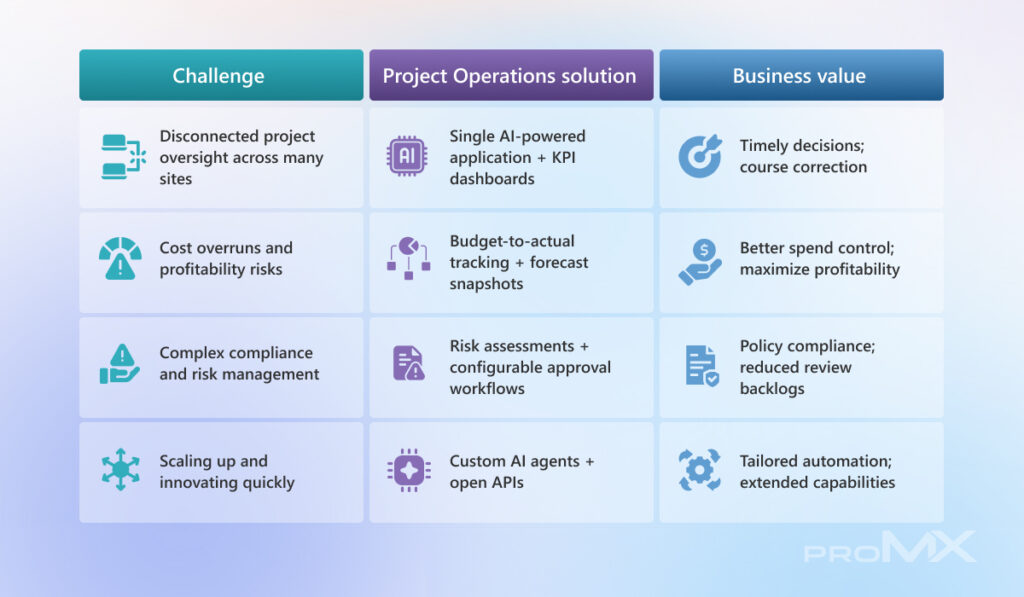
Let’s connect the dots between the challenges of the energy transition and the solutions that Dynamics 365 Project Operations can provide. Below, you can see how the solution directly addresses the practical challenges of the green energy transition:
A real-world example: Through spreadsheets to the stars
As a long-time, award-winning Microsoft partner, specializing in Dynamics 365, proMX is keen on helping businesses digitally transform their processes. One of our customers is a European energy and building technology provider. They reached a point where its existing tools could no longer keep up with the way the business was evolving. The company was working across a fragmented mix of systems, Excel-based calculations, and manual data transfers into SAP and other platforms. As a result, it slowed work down, created avoidable errors, and made it harder to get a clear view of what was happening across quotes, projects, and financials.
The pressure was especially visible in the photovoltaic part of the business. An earlier setup supported the electrical side well enough, but it did not cover the more complex needs of the PV unit, particularly automation, product data, and layouts. At the same time, the wider project business still had gaps in task management, project controlling, documentation, billing, and resource planning.
The company chose a platform-based approach built on Microsoft Power Platform and Dynamics 365 Project Operations, with SAP integration as a key part of the model. The first MVP was delivered in less than six weeks, and later phases expanded the solution further while keeping the same foundation in place.
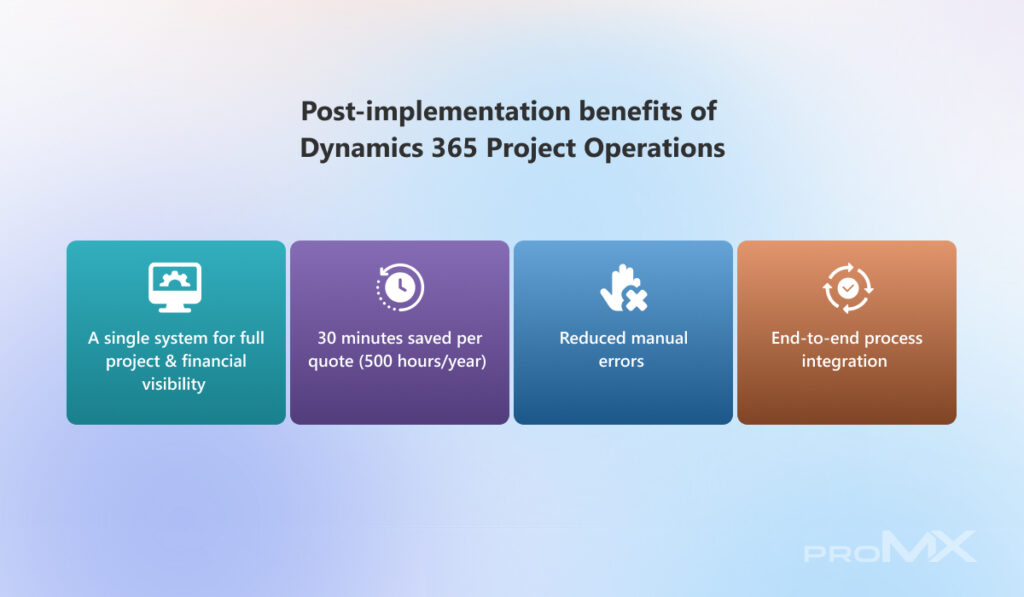
The result was a more connected way of working. Quotes, projects, and invoices were linked in one system, users gained a clearer view of project and financial data, and automation helped send consistent information directly to SAP. The company now saves about 30 minutes per quote (which is roughly 500 hours a year) and has a stronger data foundation for future analytics and AI-driven improvements.
Conclusion
Transitioning from fossil fuels to renewable energy is a journey with high stakes. However, with the right operational toolkit, it’s a journey you can lead confidently.
Interested in learning more? Consider exploring Dynamics 365 Project Operations or similar integrated solutions with an experienced Microsoft partner like proMX.
Ous goal is to assist businesses with their digital transformation, cloud migration projects, and the realization of agile organizational structures. We focus on Microsoft Business Applications, most notably Dynamics 365, for which we also develop compatible apps.
Leave us a message and let’s discuss all of your options together!
FAQ
Why are renewable energy projects harder to manage than traditional ones?
Renewable energy projects are inherently harder to manage than traditional fossil fuel projects because of intermittency, complex supply chains, regulatory hurdles, and grid integration challenges. These factors introduce higher risk and uncertainty throughout the project lifecycle.
Can Project Operations work with systems like SAP?
Yes. Project Operations can connect with systems like SAP, so data flows smoothly between quoting, project delivery, and financial processes.
Can Project Operations scale as the business grows?
Absolutely! Dynamics 365 Project Operations is built to grow with the business, so companies can add more projects, teams, or services without making things more complicated.