

Integration as a strategy: Why the best project ecosystems aren’t built around one tool
Content
Highlights
- Successful project organizations focus on reducing disconnected processes, not simply reducing the number of applications they use.
- The idea of a single platform replacing every project-related tool is often unrealistic because different business functions have different requirements.
- Dynamics 365 Project Operations is designed to be part of a broader ecosystem, working alongside other Microsoft solutions, partner applications, and external systems.
- Integration frequently delivers greater business value than system replacement by preserving existing investments while extending capabilities.
- AI-powered project delivery depends on connected data and business context, making integration and interoperability increasingly important.
Reducing complexity by consolidating tools is a logical goal for organizations to have: Fewer systems should mean lower costs, simpler processes, and less maintenance. Right? Well, reality looks different, because the more organizations try to force every business process into a single application, the more compromises they make.
Each department has different needs: Project teams need flexibility, finance teams need governance, sales teams need customer visibility, and operations teams need consistency. However, finding one platform that excels equally across all these domains is difficult, and successful organizations are realizing that the objective should not be to eliminate every tool in the landscape. Rather, the objective should be to ensure that every tool has a clear role within a connected ecosystem.
The myth of the all-in-one platform
Technology vendors like to position their solutions as comprehensive platforms: one system, one data model, one source of truth. It’s an appealing promise, but business reality isn’t that simple, at least rarely.
Project-based organizations operate across a wide spectrum of activities: Some tools help teams manage tasks and collaborate; others focus on project planning, resource allocation, budgeting, billing, customer engagement, or ERP processes. Each category has evolved to solve a different problem.
Attempting to consolidate every function into a single application often creates a different kind of complexity, because teams end up adapting their processes to the limitations of the software instead of selecting tools that support the way they work.
When it comes to Dynamics 365 Project Operations, it is positioned within this broader ecosystem rather than as a replacement for every category of project software.
Building an ecosystem instead of chasing a monolith
Organizations can choose the capabilities they need rather than implementing an entire suite by default. The platform is designed to build on the strengths of Dynamics 365 applications, the Power Platform, Finance, partner solutions, and external systems where appropriate.
That philosophy reflects a broader shift in enterprise technology strategy.
Organizations are moving away from the idea that every business requirement must be solved by a single vendor. Instead, they are building ecosystems that combine specialist capabilities while maintaining consistent processes and data. The result is an effective technology landscape where every system has a clearly defined purpose.
Why integration often creates more value than replacement
One of the most telling examples is the relationship between Dynamics 365 Project Operations and SAP: Organizations running SAP are not expected to replace their ERP investment simply to adopt Dynamics 365 Project Operations. Instead, scenarios in which Dynamics 365 Project Operations handles project delivery processes while financial processes remain in SAP through integration are much more favorable.
That approach acknowledges a reality many organizations face: Replacing a proven system may not be the best business decision, because sometimes the greater value comes from extending existing capabilities rather than rebuilding them elsewhere.
The same principle applies beyond ERP systems. Collaboration tools, industry-specific applications, CRM platforms, portfolio management solutions, and financial systems all serve distinct purposes. Rather than forcing these capabilities into a single platform, organizations can connect them in a way that preserves the strengths of each.
Integration allows businesses to evolve incrementally instead of undertaking disruptive replacement projects every few years.
How do I decide what should integrate and what should be consolidated?
The challenge is determining where consolidation creates value and where integration delivers better outcomes. A useful rule of thumb is this:
Consolidate where consistency matters, and integrate where specialization creates value.
Processes that depend on governance, compliance, financial accuracy, or organizational visibility generally benefit from consolidation. These areas often require a single source of truth. Examples include:
- Project financials
- Budgeting and forecasting
- Resource allocation
- Contracts
- Billing and invoicing
Not surprisingly, these are also areas where Dynamics 365 Project Operations focuses heavily on creating structured, governed processes. Budgeting, costing, resource management, billing, and financial oversight are central capabilities within the platform.
Specialized processes, however, frequently benefit from integration:
- Team collaboration platforms
- Industry-specific applications
- Specialist planning tools
- Portfolio management solutions
- Existing ERP platforms
Before making a technology decision, leaders should ask three questions:
- Does this process require a single source of truth?
- Is it closely tied to governance, compliance, or financial outcomes?
- Would a specialist solution provide significantly better functionality?
If the answer to the first two questions is yes, consolidation may be the right choice. If the answer to the third question is yes, integration may be the better strategy.
The future belongs to connected ecosystems
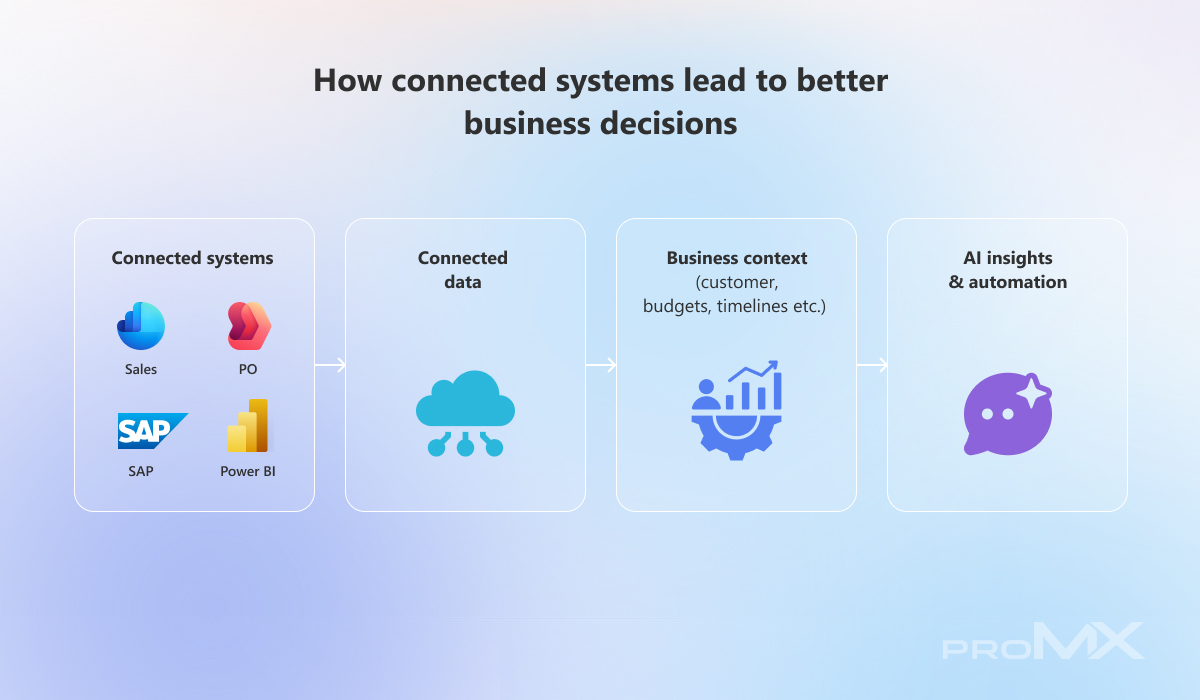
As organizations adopt AI, this principle becomes even more important. Connected systems create connected data, connected data creates context, and context is what allows AI agents and copilots to deliver meaningful insights and automation.
The value of AI depends largely on its access to business context. When information is spread across disconnected applications, opportunities for automation, insight generation, and decision support remain limited. Connected ecosystems help eliminate unnecessary administrative effort while enabling teams to focus on high-value project work.
Rather than consolidating everything into a single application, many organizations are moving toward environments where data and processes can flow seamlessly across multiple systems.
Conclusion
For years, technology strategies have been driven by a simple assumption that fewer tools are better. But the most successful project organizations are discovering a more nuanced reality: their goal is not to have fewer applications, but to have fewer disconnected processes.
Therefore organizations should evaluate their technology based on how effectively their platform fits into a broader ecosystem.
Ready to build the foundation for AI-powered project delivery? Our experts help organizations connect project, resource, financial, and operational data across systems, creating the context needed for more effective reporting, automation, and AI-assisted decision-making. Schedule a consultation!
Frequently Asked Questions (FAQs)
Does Dynamics 365 Project Operations replace every project management and ERP system?
No. Dynamics 365 Project Operations is designed to fit into a broader technology ecosystem. Organizations can integrate it with existing ERP systems, collaboration tools, industry-specific applications, and other business solutions where it makes sense.
How do I decide whether to consolidate or integrate a business process?
A useful guideline is to consolidate processes that require governance, compliance, financial accuracy, and organizational visibility, while integrating processes where specialized functionality creates greater value.
Why is integration becoming more important in the age of AI?
AI solutions rely on business context to generate meaningful insights, recommendations, and automation. Connected systems create connected data, which helps organizations unlock more value from AI-powered tools and copilots.



RECENT POST
OUR EVENTS