

Is prompt engineering obsolete? Context as the new prompt
Content
Highlights
- Prompt engineering is not obsolete, but it is evolving into context engineering.
- Modern AI models require less prompt optimization and rely more on understanding user intent.
- The performance of enterprise AI systems depends on context, tools, data access, governance, and human oversight.
- Context engineering focuses on providing AI with the information, memory, and resources needed to complete tasks successfully.
- Effective AI solutions rely on delivering the right context at the right time, not simply adding more instructions.
A few years ago, prompt engineering was one of the hottest skills in tech. You probably remember every third LinkedIn post promising secret prompt formulas. Entire courses were built around role prompting, magic phrases, and prompt templates designed to squeeze better results out of ChatGPT and other large language models (LLMs).
Fast forward to today, and the conversation has changed. AI models understand intent better, and agentic systems now can plan, reason, and use tools autonomously. It’s no surprise that a growing number of industry professionals are asking: Is prompt engineering becoming obsolete?
In this article, we are going to provide you with an overview of the prompt engineering evolution and why context engineering is becoming more and more relevant for today’s communication with AI models.
Why prompt engineering suddenly feels less important
If you’ve been working with AI since the early ChatGPT days, you’ve probably noticed that prompting techniques that felt essential in 2023 matter much less today. Remember when every prompt started with: “You are an expert consultant with 20 years of experience…”? Or when adding “Let’s think step by step” could dramatically improve results?
As models have become more capable, many of these tricks have lost their edge. Today’s reasoning models can often infer intent from relatively simple instructions. At the same time, LLM model providers are actively reducing the need for prompt expertise. Instead of making users learn how to communicate with machines, they are teaching machines how to better understand humans.
The easier AI becomes to use, the less visible prompting becomes. From a user’s perspective, prompt engineering can look like a disappearing skill. But that’s only half of the story.
The issue with the “prompt engineering is dead” narrative
The claim that prompt engineering is obsolete usually assumes that prompting is only about writing instructions in a chat window, which it is not. When building AI solutions, you quickly discover that success depends on much more than a single user prompt.
Consider a typical enterprise AI assistant. Its performance depends on questions such as:
- What information can it access?
- Which documents should it retrieve?
- What tools is it allowed to use?
- What actions can it perform autonomously?
- What should happen when confidence is low?
- How should outputs be evaluated?
- When should humans intervene?
None of these challenges are solved through clever wording alone, yet all of them influence how effectively an AI system behaves. This is where the conversation shifts from prompting to something much broader.
Context is becoming the new prompt
One of the most important concepts emerging in the AI industry is context engineering. While prompt engineering focuses on instructions, context engineering focuses on everything the model sees, remembers, retrieves, and uses to complete a task.
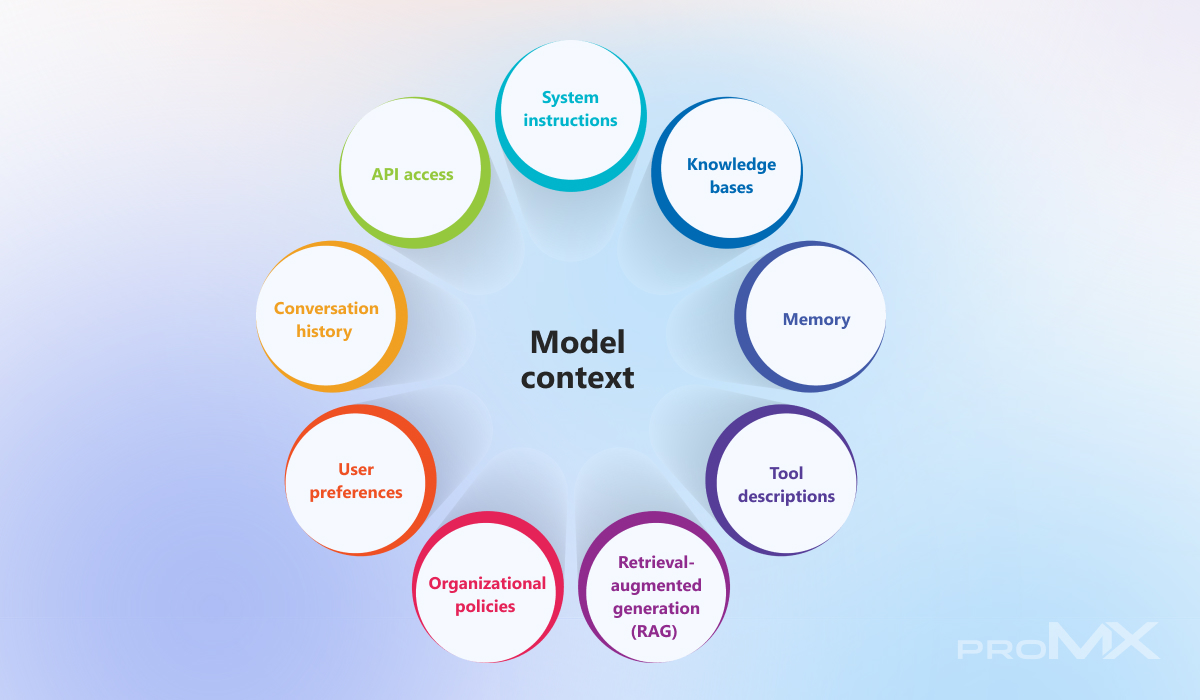
The main question shifted from “What should I tell the model?” to “What does the model need to know in order to succeed?”, or even, “How to make a model understand which info is relevant for a particular task?”. As AI systems become more sophisticated, you will spend less time tweaking prompts and more time designing the environment in which AI operates.
When more context becomes too much context
A useful example of this shift comes from the developer world. The .github/copilot-instructions.md file (and other vendor-specific implementations such as AGENTS.md, CLAUDE.md, GEMINI.md for Gemini CLI) serves as a persistent instruction layer that is automatically included in the model’s context. In coding agents such as GitHub Copilot CLI, Claude Code, and Gemini CLI, these files function similarly to a system prompt, providing project-specific guidance, conventions, and constraints. In other words, it is a way to stop repeating the same instructions at the beginning of every AI coding session.
For a while, this seemed like the obvious direction. If better prompts produced better results, then more persistent instructions should produce even better results. But the industry is now learning that this logic has limits.
Boris Cherny, the creator and Head of Claude Code at Anthropic, has argued that when a CLAUDE.md file grows too large, the better move may be to delete it and start fresh. He suggests this should be done every 6 months or so. Old context can simply become technical debt.
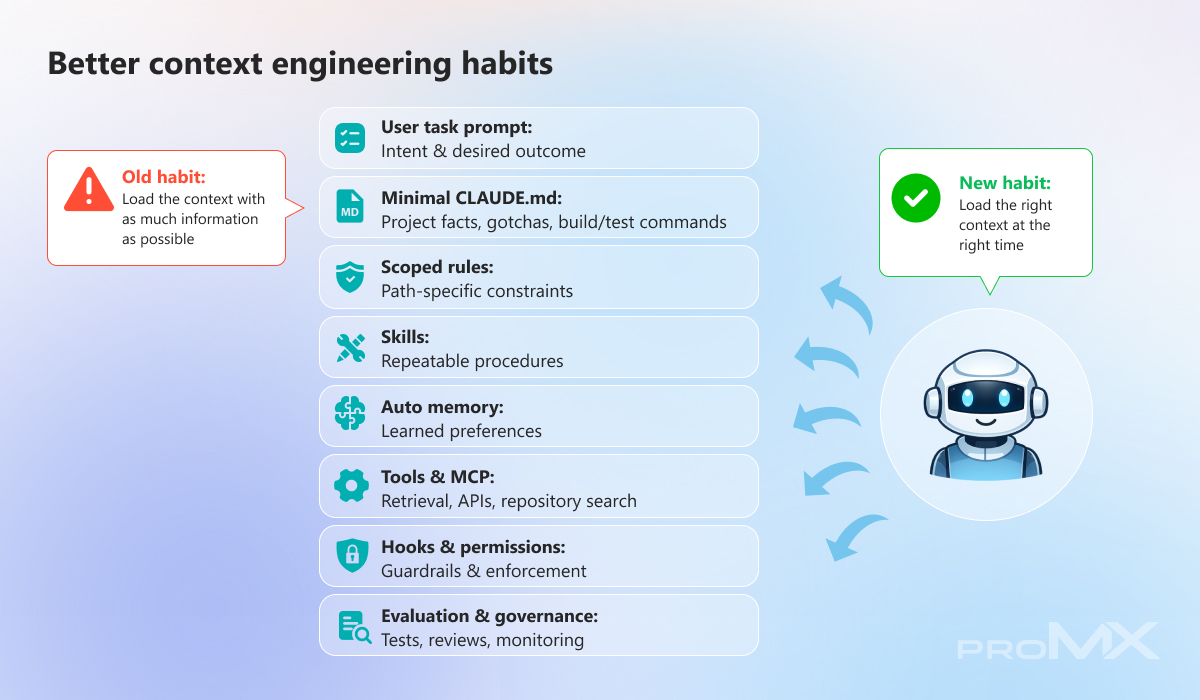
This became especially relevant with newer models such as Claude Opus 5. Anthropic’s own guidance says Opus 5 verifies its own work, delegates more readily to subagents, and can handle longer, more complex agentic tasks. That means instructions written for weaker models, for example, “always double-check your work” or “add a final verification step”, may now simply add extra cost and unnecessary behavior.
Conclusion: Prompting is still there
The most important prompt may no longer be the one the user types. Instead, it is the architecture that decides what the AI sees, remembers, retrieves, and is allowed to do. Regardless, clear instructions, well-defined goals, and thoughtful communication with AI systems still matter.
In fact, as organizations move from experimenting with chatbots to deploying AI-powered business processes, the stakes become much higher.
At proMX, we help businesses move beyond AI experimentation and build practical, business-ready solutions in the Microsoft ecosystem. Whether you are exploring Microsoft 365 Copilot, Copilot Studio custom agents, agentic workflows, or enterprise AI governance, our experts can help you create the right foundation for long-term success.
Ready to turn AI potential into measurable business value? Contact the proMX team to discuss how we can support your AI transformation journey.
FAQ
What is context engineering?
Context engineering is the practice of designing everything an AI system uses to complete a task, including system instructions, knowledge sources, memory, conversation history, policies, tools, and retrieval mechanisms.
Can too much context reduce AI performance?
Yes. Excessive or outdated instructions can become a form of technical debt. AI experts increasingly recommend keeping persistent instructions focused, and make sure models receive only the context needed for a specific task.
What does the shift from prompt engineering to context engineering mean for organizations adopting AI?
As organizations move beyond simple chatbot experiments and deploy AI-powered business processes, they need to focus on governance, architecture, data access, and context management. Building the right foundation helps ensure AI delivers reliable and measurable business value.



RECENT POST
OUR EVENTS