




AI transformation starts with the business challenges
Content
Highlights
- Successful AI transformation begins with a clearly defined business challenge.
- AI creates greater value when it brings together the context people need to make informed decisions.
- Businesses should define how responsibilities are divided between people and AI as agents take on more execution.
- AI can support decision-making across operations.
- Effective AI initiatives connect technology to business outcomes.
Artificial intelligence has quickly moved from an emerging technology to a business priority. Companies are experimenting with copilots, agents, different ways to automate things, and increasingly sophisticated AI models. It seems like every company is supposed to have developed some sort of AI strategy, and employees have no other choice but to use AI in their daily work.
But there is an issue with how exactly many of these AI conversations begin. The first question is often: Where can we use AI? But using technology just for the sake of using it can easily lead you toward isolated use cases that demonstrate what AI can do without improving how the business works. A more useful starting point would be: What business challenge are we trying to solve?
In this article, we will talk about why businesses should look beyond AI adoption, focusing on the processes that AI can help improve. Besides that, we will explore how solutions like proMX Companions can bring this approach into everyday business scenarios.
The difference between AI adoption and AI transformation
There is nothing wrong with starting small. Using AI to summarize information here, generate content there, search through documents, or automate repetitive activities can save quite some time. But adding AI to an existing process does not automatically make that process better.
If a manager has to combine information from six different sources before making a decision, generating a seventh summary may simply add another layer. If an approval regularly takes a week because nobody has the necessary context, automating part of the workflow may accelerate activity without improving the decision itself. This is where organizations need to look beyond individual AI features and examine the work around them.
Sometimes the biggest opportunity is to reconsider how information reaches people and how issues are detected in the first place. That is the difference between AI adoption and AI transformation.
| AI adoption asks | AI transformation asks |
| Can AI create this report? | Can we identify the risk earlier? |
| Can AI summarize this data? | Can we connect the context needed for a decision? |
| Can AI automate this task? | Why does this task require so much human attention? |
| Where can we implement AI? | What business outcome needs to improve? |
From fragmented data to decision context
This shift is particularly important because most business issues do not live neatly inside one system. A delivery problem can affect schedules, resources, revenue, and customer commitments simultaneously. People often become the integration layer themselves when they have to open several applications, ask colleagues for missing information, and manually reconstruct the story behind a problem. AI creates an opportunity to change that pattern.
This is also where Microsoft’s idea of the Frontier Firm becomes relevant. Microsoft describes Frontier Firms as organizations built around on-demand intelligence and hybrid human-agent teams. Its 2025 Work Trend Index outlined a progression from AI acting as an assistant, to agents joining teams as “digital colleagues”, and ultimately toward human-led, agent-operated workflows.
The scale of the shift is significant. In Microsoft’s 2025 research, 82% of leaders said that year was pivotal for rethinking key aspects of strategy and operations, while 81% expected agents to be moderately or extensively integrated into their AI strategy within the following 12 to 18 months.
Microsoft’s newer Work Trend Index research continues the discussion around agents, human agency, and whether organizations are structured to capture the opportunity as AI takes on more execution. The important implication is that every company needs to decide how work should be divided between people and AI.
How ready is your business for AI? If you are considering your next AI initiative and want to understand where your organization currently stands, proMX can help you assess your AI readiness and determine practical next steps.
Contact proMX for a free consultation and discuss where AI can create meaningful value for your business.
The practical side of AI transformation
A useful way to understand the difference is to look at concrete business decisions.
- Project management: Instead of asking AI to summarize a project plan, use AI to identify schedule risks, reveal dependencies, and highlight where intervention could make the greatest difference.

- Portfolio management: Instead of producing another portfolio overview, bring together information about initiatives, dependencies, resources and financial impact so leaders can evaluate priorities and trade-offs.

- Finance: Instead of simply flagging a financial anomaly, trace the issue to its underlying transactions and give finance teams the context needed to investigate it.

- Workforce management: Instead of reporting utilization as a KPI, examine how time is actually being used and identify operational gaps or recoverable capacity.
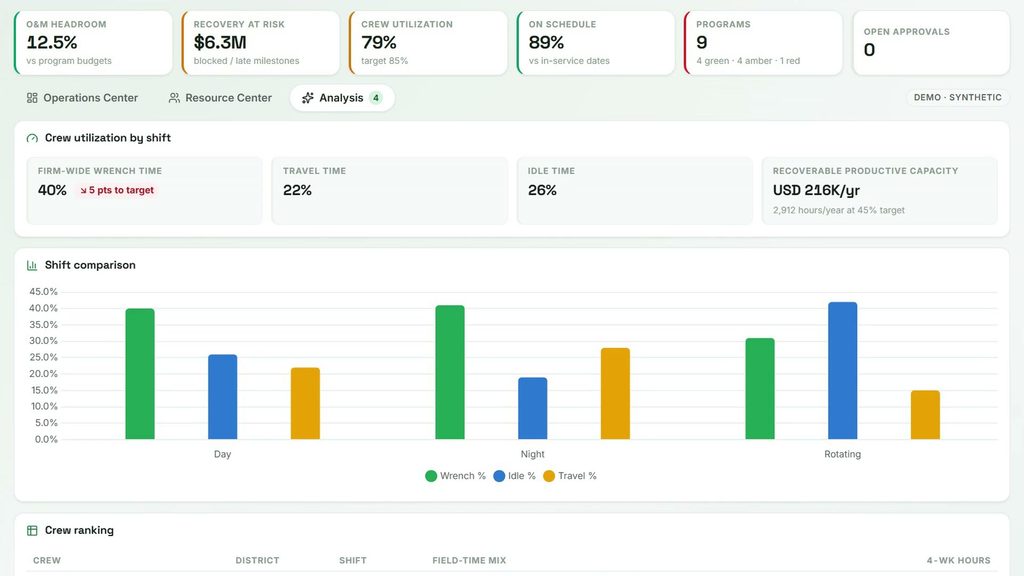
- Campaign management: Instead of notifying a team that a disruption occurred, evaluate its downstream impact across plans, budgets, supply and capacity and present possible responses for consideration.

These are the types of scenarios explored through proMX Companions. The current portfolio includes Project, Portfolio, Finance, Workforce, and Campaign Companions, each designed around different business questions and decisions. AI becomes more valuable when it is organized around a business decision rather than around an AI capability.
Five questions to ask before AI implementation
Besides a promising use case, you also need the right conditions to introduce AI responsibly and turn experiments into repeatable business processes.
A quick readiness check can cover five areas:
- Strategy: Is there a clear reason for using AI, someone responsible for the initiative, and a budget for experimentation?
- Data and security: Does the team know which information can and cannot be entered into AI tools? Are policies and usage audits in place?
- Technology: Are employees using approved corporate accounts and tools? Is there a process for testing new AI solutions and evaluating their accuracy and risks?
- Team and culture: Do employees receive training and internal guidance on acceptable AI use? Is the quality of AI-generated output reviewed?
- Operational integration: Are AI-supported processes clearly defined, governed by an AI policy and evaluated for effectiveness on a regular basis?
Conclusion
AI can provide many opportunities to automate your work. The greatest value comes from applying its capabilities to challenges that matter to the business and designing the process around the outcome you want to achieve.
Solutions such as proMX Companions put this approach into practice across project, portfolio, finance, workforce, and campaign management. Each Companion focuses on specific business questions and helps turn available data into useful context for decision-making.
Explore how AI is shaping the next generation of project portfolio management in our article on the future of project portfolio management.
FAQ
1. What is AI transformation?
AI transformation is the use of AI to improve how work gets done across an organization. It can involve connecting information, identifying risks, supporting decisions, and redesigning processes around better business outcomes.
2. Why should AI initiatives start with a business challenge?
A clearly defined business challenge gives the AI initiative a purpose and provides a basis for measuring success. It also helps organizations determine what exactly would be relevant to the process.
3. What is the difference between AI adoption and AI transformation?
AI adoption typically introduces AI into individual tasks. AI transformation looks at the wider process, including how information flows, how issues are detected, and how decisions are made.
4. What role should people have in AI-powered processes?
AI can monitor signals, connect information, investigate causes, and prepare recommendations. People can evaluate trade-offs, contribute additional context, and remain responsible for consequential decisions and actions.
5. How can businesses measure the success of AI transformation?
Success should be tied to the original business objective. Relevant measures could include faster decision-making, earlier risk detection, reduced investigation effort, improved utilization, or another KPI directly connected to the problem being addressed.
RECENT POST
OUR EVENTS

