
Dynamics 365 Project Operations and Finance: Choosing the right deployment model
Content
Highlights
- Disconnected systems create friction: Separate Project Operations and Finance setups often lead to manual work, inconsistent reports, and limited visibility.
- Integration builds connection: Dual-write helps project and finance teams work from the same numbers.
- Deployment choice depends on complexity: Each model fits different business needs, from manufacturing-heavy setups to project-centric organizations.
- Technical planning matters early: Dual-write, field mapping, ALM, and custom requirements can quickly increase implementation complexity.
- The decision is business-driven: The right model depends on ownership, invoicing processes, and how closely teams need to collaborate.
Although projects span departments such as finance and operations, the goal is always the same: deliver them on time, stay within budget, and contribute to long-term profitability.
What keeps most of them divided is the system they work with: while project teams track progress in systems like D365 Project Operations, finance leaders track numbers in F&O, which leads to manual reconciliation and conflicting reports.
As many organizations try to navigate this challenging situation, some of those look for deployment options. But which Project Operations deployment model provides the right division of responsibilities between project delivery and finance?
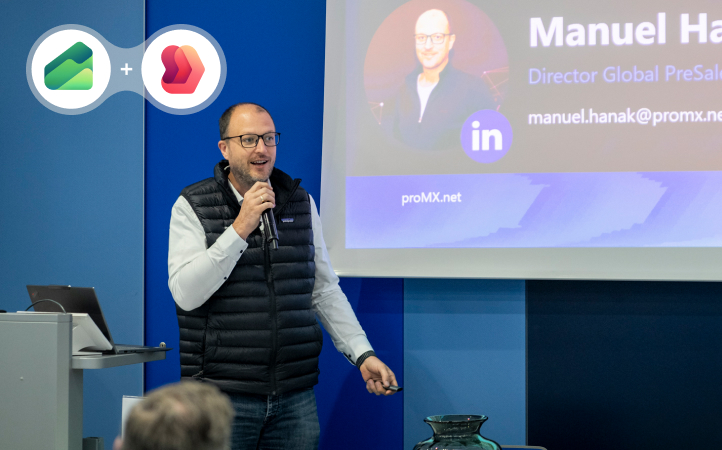
Based on insights from the proMX PO + AI Summit 2026 session by Manuel Hanak, Global Presales Director (proMX), and Paul Schörghofer, Senior Consultant (Arineo), this article helps project managers and finance teams understand what to consider before choosing an integration approach, which models fit different scenarios, and how to make informed architecture and process decisions.
What are the advantages of integrating Project Operations and Finance?
For projects to run smoothly, it is important to guarantee well-connected systems, and this is when integrating D365 Project Operations with Finance becomes essential.
Below, we have listed the most common advantages for businesses that decide to integrate Project Operations and Finance.
Easier data transfer in real time
The integration of both Dynamics 365 solutions offers one of the most relevant perks for project-centric teams: data synchronization in real time. If CFOs and PMs have access to the same numbers, there’s no need to manually enter information, which saves time and stress along the way.
More efficiency and user satisfaction
By integrating Project Operations and Finance, both project managers and accountants working on the same projects can be more efficient within an interconnected system while keeping their individual work in their preferred app. This ensures more satisfaction for the users then choosing an entirely new solution and having to adapt to a new system.
Improved financial visibility and control
For finance teams, it can be frustrating to correct project figures after the fact, explain variances instead of preventing them, and close the books with more stress than confidence. On the other hand, project teams face a lack of financial visibility, which can lead to decision-making based on outdated data. After the integration of Project Operations and Finance, both teams can make better budget forecasts and gain full control of the project’s financials.
Fewer reconciliation delays and faster financial handovers
Finally, one of the advantages of integrating D365 Project Operations and Finance is having fewer reconciliation delays in the long term. By connecting both systems, teams can streamline project delivery and financial processes effectively and avoid data mismatches or wrong predictions.
Why the integration choice matters: The 3 deployment options for Finance and Project Operations
Now that you have an overview of the main benefits, the real question is not whether Project Operations and Finance should be integrated. It is which deployment model provides a better fit for the organization’s end-to-end Project-to-Profit process.
Let’s deep dive into the three types of integration models for Project Operations and Finance.
1. Project Operations for manufacturing
Project Operations for manufacturing is designed for project scenarios in which stocked materials, production orders, inventory, procurement, and supply-chain processes are closely connected to project execution. It is the stronger fit where project delivery cannot be separated from the organization’s broader manufacturing and ERP processes. As the project module is complex and highly integrated, it is common for consulting, engineering, or project-based businesses to choose other deployment modules.
2. Project Operations Core
The second model companies can also choose is the Project Operations Core model, having Project Operations as a standalone solution with custom integration. Project Operations Core can run in Dataverse and supports project sales and delivery through proforma invoicing. Organizations can connect it to Dynamics 365 Finance or another ERP when they want to retain separate ownership of final invoicing, accounting, revenue recognition, or other financial processes. This is not the standard Integrated with ERP deployment. The process handover, data ownership, integration technology, error handling, and reconciliation approach must be designed specifically for the customer.
One of its main benefits is that it is customizable and can adapt to special requirements, such as transferring additional fields or handling intercompany cost allocation. However, customization also comes with additional complexity in interface and ALM processes and may be less suitable for companies that are deeply involved in manufacturing, logistics, or warehousing, where integrated project modules in F&O are necessary for production and inventory management.
3. Project Operations integrated with ERP
Finally, there is also the integrated deployment. Project Operations integrated with ERP is Microsoft’s standard architecture for connecting project delivery in Dataverse with project accounting and financial control in Dynamics 365 Finance. In this model, Microsoft-provided Dual-write components synchronize the relevant data across the two environments. Project delivery and management are handled in Project Operations, while financial and accounting tasks are managed in F&O. As a result, this out-of-the-box integration is easier for most scenarios and is particularly suitable when customer-facing invoicing, tax, currencies, financial dimensions, expenses, project accounting, and revenue recognition are integral parts of the project lifecycle. At the same time, personas can keep working in their preferred system: front-end users in Project Operations and back-end users in F&O. To prevent duplicate ownership and inconsistent processing, some overlapping project-management experiences in Finance are restricted.
Main technical challenges during integration
From a technical perspective, integrating Project Operations with Finance & Operations is less about “plug-and-play” and more about making the right architectural decisions early on.
First, the dual-write setup itself can become complex. It requires extensive table and field mappings, along with careful validation and synchronization, especially in larger environments.
Second, as the standard integration supports the defined Project-to-Profit scenario, additional design may be required where customers introduce custom data, specialized invoicing, complex intercompany requirements, or responsibilities outside the standard model. Many scenarios require additional fields or logic that aren’t covered out of the box, making custom dual-write configurations or separate interfaces necessary.
Another important factor is the difference in ALM processes between the Finance and Dataverse sides. These differences affect how changes are deployed and maintained and can slow down implementations if not aligned early on.
At the same time, the integrated model has limits in flexibility. More complex cases, such as specific invoicing scenarios or intercompany processes, often require custom integration approaches.
Real use cases, real results: How companies are benefiting from both solutions
During the session at the PO Summit 2026, two real implementation use cases were presented: one coming from a professional services company and the other from a consulting software firm. Both examples showed that the most suitable deployment option depends heavily on the company’s business model, operational needs, and process complexity.
Professional Services (Consulting and Engineering company)
The first example was a company from the professional services sector specializing in consulting and engineering. They had minimal inventory, were working on resource-based projects with subcontractors, doing milestone billing, and intercompany cost allocation. The company chose the light deployment with customized dual-write integration to support complex invoice requirements and cost center transfers. While other companies may have final invoices and no need for customization, in this example the company needed a system that allowed them to issue both partial and final invoices, each with their own unique design. This is the reason why the final invoice preparation needed to be handled by the finance team in F&O. The PO integrated with ERP model would not provide the required level of control over this customer’s specific invoice preparation process and Finance-side project functions without further extension.
Consulting/ Software Company
The second and last use case mentioned during the session showed how having mixed project work (implementations and product sales) with recurring invoices, as it was the case for the consulting and software company, can be easily managed with an integrated deployment. As the company’s recurring billing process was managed in Finance, both project and sales order invoices were managed separately. Both teams working on the invoicing operated independently, with no need to combine invoices, so integrated deployment was selected for simplicity and faster implementation.
Conclusion: What is the right deployment model for your business?
All in all, the right integration model for your organization is the one that fits your needs. For organizations that use Dynamics 365 Finance and require integrated project accounting, revenue recognition, tax, currency handling, financial dimensions, and customer invoicing, Project Operations integrated with ERP is often the natural standard architecture.
Project Operations Core can be the better fit where project sales and delivery should remain in Dataverse and the organization wants a selective handover to an existing ERP or a separately controlled Finance process. However, this requires an explicitly designed integration, clear systems of record, and robust reconciliation and error-handling responsibilities.
Manufacturing and stocked-material scenarios require a different perspective because project execution is closely connected to inventory, production, procurement, and supply-chain processes.
Your choice of model depends heavily on the process complexity and your specific requirements, and customizations may be needed in some cases. The important thing is that you see the deployment decision not as a technology decision but rather as a business process and ownership decision.
To know more on this subject, please watch the full session by proMX expert Manuel Hanak and Paul Schörghofer, Senior Consultant at Arineo, below:
If you need guidance on how to choose the right deployment model, get in touch with our team of experts in Dynamics 365 solutions!
FAQ
What are the three deployment types for Project Operations and Finance?
The three deployment types are Project Operations for manufacturing, Project Operations Core, and Project Operations integrated with ERP. The right choice depends on whether your projects are manufacturing-heavy, require a tailored handover to Finance or another ERP, or need Microsoft’s standard integration for project accounting, invoicing, and financial control.
What is the main factor to consider when choosing a deployment option?
Before choosing the deployment model, make sure you ask yourself who is responsible for each process and how your teams, e.g., finance and accounting, work on project financials. Who owns project delivery? Who prepares and posts the invoice? Where does project accounting take place? You should only define the integration demands after mapping out the ownership and business processes.
Do I need a partner to integrate D365 Project Operations and Finance?
In most cases, yes. The integration involves complex dual-write setup, custom mappings, and aligning different ALM processes. While technically possible to handle internally, many projects require extensions and clear decisions around configuration and ownership. Working with an experienced partner helps structure these early, reducing complexity and avoiding rework.



RECENT POST
OUR EVENTS