

How Dynamics 365 Contact Center narrows the hidden gap between your business and your customers
Content
There is a huge difference between what you see and what your customer sees when it comes to customer service. Even if everything goes according to the procedure from the inside, this process doesn’t always feel optimal on the outside.
Picture this: a customer reaches out to support with what they consider a simple question: They ask the support team to confirm the status of their request, update a small detail, or clarify a billing item. From their perspective, it should be a one-minute, in-and-out adventure. Behind the scenes, however, the support agent may need to search across multiple systems, check customer history, consult internal notes, verify data with another team, and only then come back with a response. Even if that process takes just five minutes, you know how endless those minutes feel when you’re stuck listening to hold music or staring at a silent chat window.
So, how does one make this situation better? By identifying what’s drawing you away from your customers and finding a way to narrow down that gap. This article describes how disconnected customer service technology is holding you back and what you can do about it with modern software like Microsoft Dynamics 365 Contact Center.
What customers experience vs what agents fight daily
Customers rarely see the complexity behind a process (i. e. their request), and they shouldn’t have to. From their point of view, they are talking to one company and one service team. They expect that whoever picks up the conversation already knows who they are, what they need, and what has happened before.
What they often experience instead is repetition, delays, and subtle signs of confusion. They explain the same issue twice. They are transferred from chat to email or from one agent to another. They sense hesitation where confidence should be.
On the other side of the conversation, agents are dealing with a very different reality. They are switching between applications, pulling information from different sources, and mentally stitching together a customer’s story while the conversation is already in progress. Even highly skilled agents are forced into reactive mode, not because they lack knowledge, but because the information they need is scattered.
The invisible cost of fragmentation
Disconnected customer service systems don’t announce themselves as a problem. What they do instead is create friction that erodes not only the company’s image, but also the ROI itself.
From a leadership perspective, things may look acceptable. Service levels are technically met, and reports show stable performance. Customer sentiment, however, tells a different story. According to Zendesk Benchmark data, more than 50 % of consumers will switch to a competitor after only one bad experience. This increases the loss of income one customer at a time.
Why more tools rarely solve the problem
When organizations start to sense these issues, the instinct is often to add something new: another support channel, dashboard, or a siloed AI-powered feature. Each addition promises improvement, yet the customer experience often remains unchanged. The reason is simple: it’s a connection problem.
If new tools don’t share context, they introduce more handoffs. If automation doesn’t see the full customer picture, it creates confusion instead of efficiency. True improvement comes not from adding layers, but from narrowing gaps.
How Microsoft Dynamics 365 Contact Center supports connected experiences
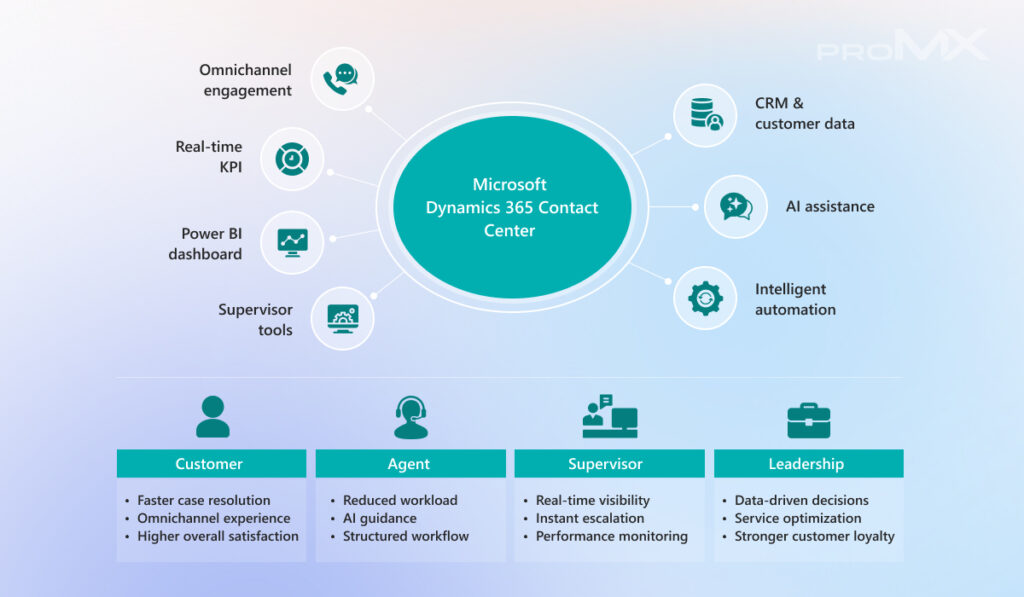
Microsoft Dynamics 365 Contact Center is built around the idea that customer service should feel continuous. By bringing omnichannel communication, customer data, case management, and AI-powered assistance into a single environment, it helps organizations reconnect what has grown apart.
Technology needs the right approach
Even the most capable platform delivers value only when it’s implemented with a clear understanding of real-world service challenges. Every organization has its own processes, legacy systems, and expectations. Connecting everything in a meaningful way requires experience, not just configuration. This is where the right partner makes the difference.
proMX helps organizations customize and implement Microsoft Dynamics 365 Contact Center with this goal in mind. Talk to an expert to assess your contact center maturity and become closer to your customers today!



RECENT POST
OUR EVENTS