

What our 2026 customer survey reveals: Key project and portfolio management pain points – and how to fix them
Content
Highlights
- Disconnected tools are the number one pain point in project and portfolio management.
- Resource bottlenecks continue to limit project success.
- Organizations struggle with lessons learned, governance, and value tracking.
- Reporting and visibility gaps still consume significant time and effort.
- Understanding your pain points is the first step toward finding the right solution.
For more than 25 years, proMX has been helping organizations manage projects, portfolios, and resources more effectively. One of the reasons we continue to grow and evolve is simple: we listen to our customers. Their challenges and experiences help shape both our products and our understanding of the industry.
That’s why we regularly ask our customers about the obstacles they face in their day-to-day work. The results of one of our recent surveys reveal a familiar story. Despite ongoing investments in project management software, many still struggle with fragmented tools, resource bottlenecks, limited visibility, manual reporting, and disconnected processes.
The interesting part is that these challenges don’t necessarily point to a need for an entirely new system. More often, they highlight gaps within an existing one that could be addressed with the right improvements and integrations.
In this article, we will talk about what paint points are the most prominent ones within project and portfolio management, and what insights can project-driven organizations draw from it.
Six pain points that show where the system starts to break
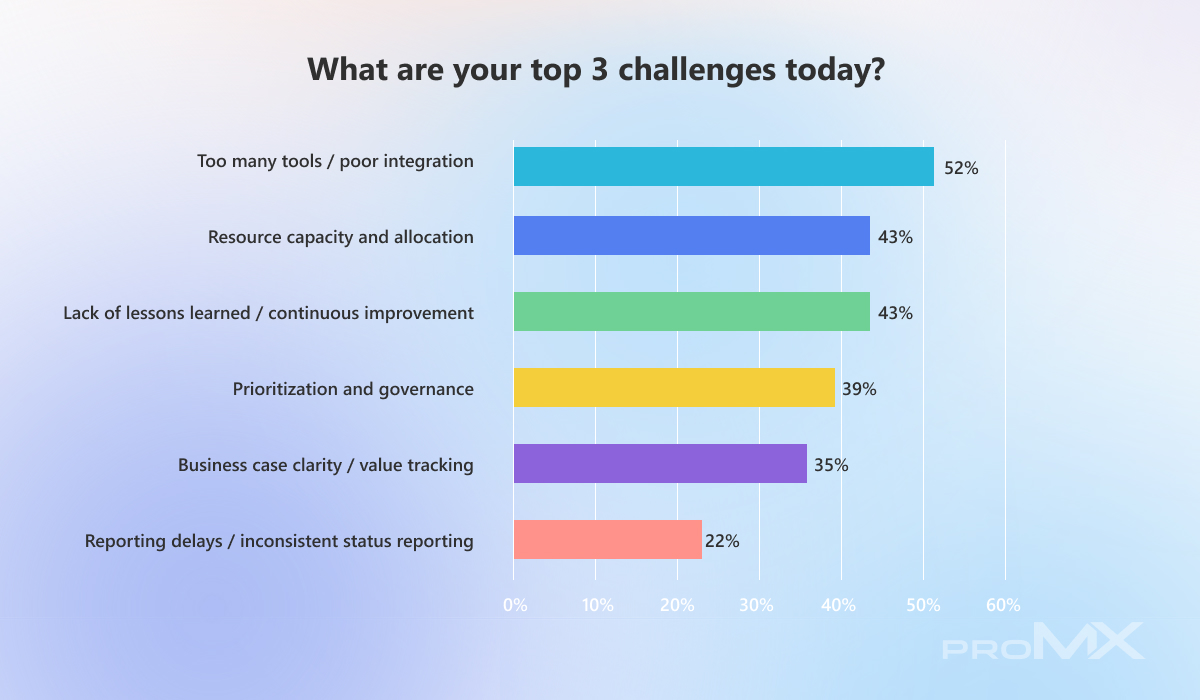
The survey results point to six areas where project and portfolio management processes most often become difficult to control:
Too many disconnected tools as the main challenge
Among many other things our existing and potential customers revealed, one result stood out immediately: 52.2% of respondents identified “too many tools” and “poor integration” as one of their top project and portfolio management challenges.
The issue becomes even more apparent when looking at the tools respondents currently use:

On the surface, having multiple tools may seem harmless, as each of them is dedicated to doing a particular job and doing it well. In practice, however, these tools live in an informational vacuum, where the changes made in one of them are not communicated to the other. This creates data silos, duplicate work, inconsistent reporting, and slower decision-making. Teams spend valuable time consolidating information instead of acting on it.
Resource management remains one of the biggest obstacles
When asked about their biggest project challenges, 43.5% of respondents selected resource capacity and allocation. At the same time, the respondents mentioned which improvements would create the biggest value for the quality of their work:

Every company wants to make the most of its people. Project managers know this challenge well: assign the right team to the right project at the right time. However, priorities shift, and people get overbooked anyway. And without a clear view across the portfolio, even your best plans start to unravel.
Lessons not learned
One of the more surprising findings was that 43.5% of respondents cited “lack of lessons learned and continuous improvement” as a major challenge.
As soon as the project is over, valuable insights and conclusions can be overlooked as time passes and the next project already being on the way. As a result, teams repeat the same mistakes, risks resurface, and project success becomes dependent on individual experience rather than organizational knowledge.
Prioritization and governance remain difficult
Another common challenge identified by 39.1% of respondents was prioritization and governance. As project portfolios grow, businesses must constantly decide which initiatives deserve resources and attention, and which should be delayed, paused, or stopped altogether.
When governance processes are unclear or inconsistent, project teams often compete for the same resources while leadership struggles to compare initiatives objectively.
Business case clarity and value tracking
According to our survey, 34.8% of respondents identified business case clarity and value tracking as a challenge. Organizations often invest significant time and resources into projects without a clear framework for measuring whether those initiatives deliver the expected value.
Before introducing new tools or processes, you should examine how project success is currently defined, measured, and communicated. A stronger connection between project outcomes and business objectives helps decision-makers focus on initiatives that create the greatest value.
Visibility and reporting still consume too much time
Reporting challenges appeared throughout the survey, taking up 21.7% of the answers. Respondents highlighted:
- Manual reporting
- Status updates
- Inconsistent reporting processes
- Difficulty obtaining reliable portfolio insights
Open-text responses reinforced this pattern, with many participants mentioning reporting, project status visibility, approvals, and risk tracking as workflows they would most like to simplify.
Instead of manually collecting information from multiple systems, you can standardize reporting and automate insight generation.
Bonus insight: AI is no longer a future discussion
Another clear message we derive from the survey concerns AI. When asked how valuable AI and Copilot-assisted capabilities would be:

Nobody considered AI entirely irrelevant. In total, 61% view AI as a high-priority or mission-critical capability.
How to decide what to fix first
Switching from one solution to another will not automatically solve your challenges. If the underlying pain points are unclear, a new system can simply recreate the same problems in a different place.
A more sustainable approach starts with a clear view of the current ecosystem:
- Which tools are already working well?
- Where do teams rely on manual workarounds?
- Which data is trusted, and which data is constantly questioned?
- Where do delays, bottlenecks, and reporting gaps appear most often?
Once these questions are answered, you can make more targeted decisions. They may not need to replace their entire setup. They may need an extension, integration, or specialized capability that closes a specific gap and strengthens the tools already in use.
Finding solutions that fit your ecosystem
Understanding your biggest challenges is only the first step. The next is deciding how to address them without creating new complexity.
In many cases, solving project and portfolio management challenges does not require replacing your entire project environment. Instead, it may be enough to strengthen the systems you already use with solutions that address specific gaps and integrate seamlessly into your existing ecosystem.
If you already work with Microsoft technologies, this often means extending existing capabilities rather than introducing yet another standalone application. The proMX 365 Productivity Suite extends Dynamics 365 Project Operations with additional capabilities for portfolio management, resource planning, time tracking, absence management, reporting, and AI-powered assistance.
For example, if resource visibility is one of your biggest challenges, proMX 365 Project Portfolio Management can help:
- View resource demand across multiple projects
- Balance workloads more effectively
- Compare alternative scenarios
- Prioritize initiatives based on available capacity
- Identify bottlenecks before they cause delivery issues
Explore the most common challenges in portfolio-level resource planning, the trends reshaping how organizations manage resources today, and how software such as proMX 365 PPM can simplify the whole game.
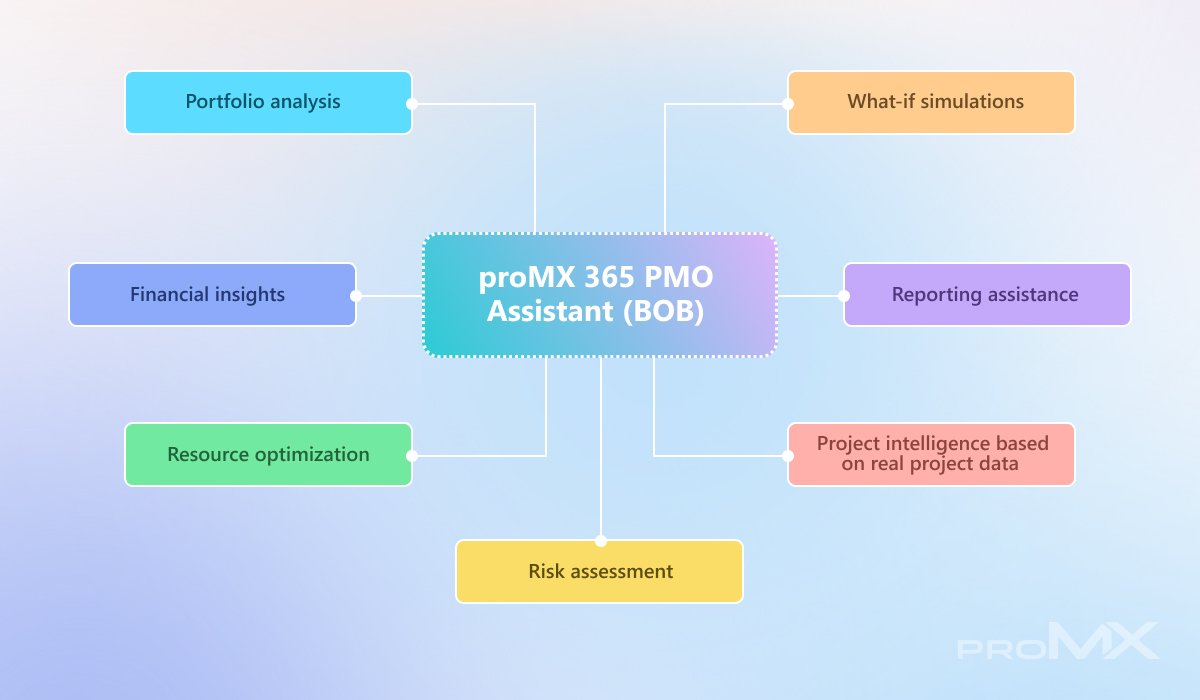
And if you’re exploring how AI can support your project environment, the proMX 365 PMO Assistant (BOB) demonstrates how AI can be embedded directly into project and portfolio management workflows through portfolio analysis, resource optimization, risk assessment, reporting support, and what-if simulations.
And finally, for project managers and delivery teams who need immediate answers at the project level, the proMX 365 Project Companion Agent provides AI-powered assistance directly within Dynamics 365 Project Operations. Simply ask questions in natural language:
- Which projects are at risk?
- Where are we likely to exceed budget?
- Which resources are overloaded?
- What actions should we take to improve project performance?
The agent continuously monitors project data and helps you identify risks, resource issues, and budget concerns. It provides recommendations, automates workflows, and helps keep projects on track without relying on manual reports.
Conclusion
The survey highlights a consistent theme across project-driven organizations: the biggest challenges are portfolio-wide visibility gaps, disconnected tools, resource constraints, and manual processes. And closing those gaps is the vision behind the proMX 365 Productivity Suite. It brings together project portfolio management, resource management, reporting, productivity enhancements, and AI-powered assistance in one integrated environment built on Microsoft technologies.
Want to see how this works in practice? Contact the experts at proMX to get a personalized sneak peek into the Productivity Suite and how it works!
FAQ
Why are disconnected tools such a problem?
When information is spread across multiple systems, teams often create duplicate work, struggle with inconsistent reporting, and spend time manually consolidating data instead of making decisions.
What role does AI play in project and portfolio management?
Survey results show that AI is no longer considered a future trend. Most respondents see AI-powered capabilities as valuable for their day-to-day work.
What is the best approach to improving project and portfolio management?
A sustainable approach is to strengthen your existing ecosystem with solutions that close specific gaps, improve integrations, and increase visibility across projects, resources, and portfolios.


RECENT POST
OUR EVENTS