

Future-proof your customer engagement with agentic CRM
Content
If your organization still relies on a legacy system, you’ve probably felt it: the software that once managed customer info and sales pipelines is now struggling to keep up. This surfaces when your sales managers spend hours toggling between screens to piece data together, or when your customer service agents can’t find answers because information is everywhere and nowhere to be found at the same time. Meanwhile, your customers are getting instant, personalized service from modern apps and wonder why your team is stuck with slow, manual processes.
Businesses are moving toward a new generation of AI-powered agentic CRM systems designed for today’s speed. This raises a big question: how can you make sure your company isn’t left behind? This article will answer why sticking with a legacy CRM is holding you back and how an agentic CRM can give your company the boost it needs to prosper, like Microsoft Dynamics 365 did for ARNOLD Group.
Why legacy CRMs become a bottleneck
Legacy CRM platforms were designed to record information and enforce predefined workflows. They work well as databases, but struggle when asked to act, adapt, or collaborate across systems. Over time, this leads to familiar issues:
- Data scattered across multiple tools
- Manual handovers between sales, service and operations
- Delays caused by searching, copying and reconciling information
- Automation that only works in narrow, static scenarios
When companies try to introduce AI on top of these systems, the cracks widen. Agentic AI depends on real-time, reliable data. Without that foundation, even the most advanced AI tools are forced to operate with incomplete context, or no context at all.
From system of record to system of action
Modern platforms like Microsoft Dynamics 365 were designed to turn data into action. Instead of siloed modules, they provide a unified environment where data from sales, service, finance, and operations is available in real time. On top of such a foundation, Microsoft Copilot thrives. It helps organizations automate routine processes, surface deep insights, make data-driven decisions, and go through loads of information that otherwise would have taken weeks to process.
Of course, every business is unique, and out-of-the-box solutions do not always touch all the bases at once. Copilot Studio allows you to adjust the system to your needs by designing AI agents that:
- Qualify and route leads
- Support customer service interactions
- Trigger follow-ups and reminders automatically
All of this happens within a governed, secure environment with predictable costs and built-in compliance. AI operates with full context, making it genuinely helpful rather than intrusive.
The ARNOLD Group case: Migrating without disruption
Of course, adopting an agentic CRM doesn’t mean stopping business operations to rebuild everything from scratch. A practical migration strategy focuses on moving and improving at the same time.
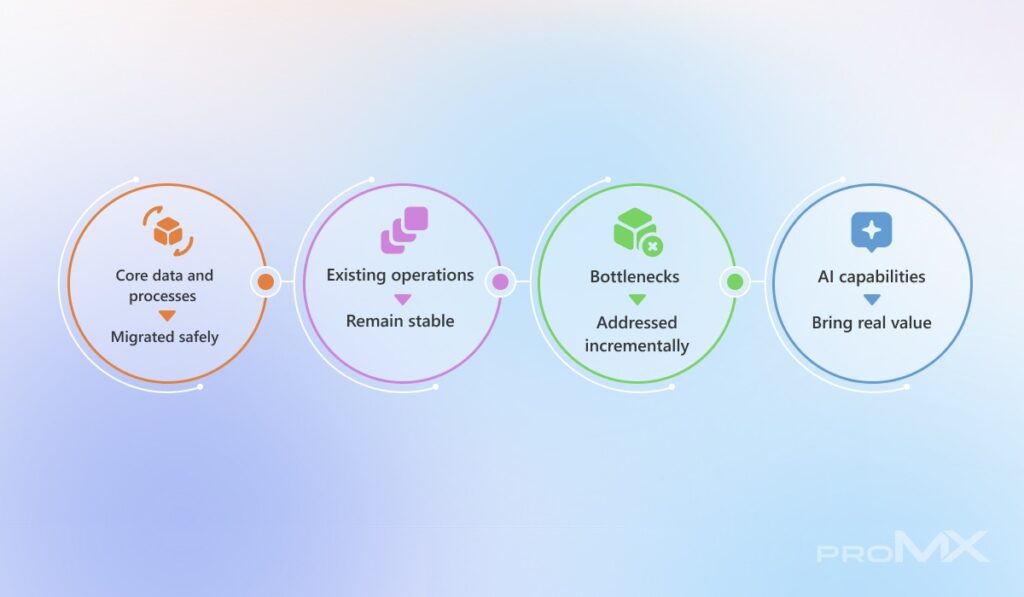
What this kind of transition looks like in practice can be seen in the experience of the ARNOLD Group, a global manufacturing company that set out to modernize its sales operations. The organization was working with a heavily customized legacy CRM that made it difficult to maintain consistent data, scale processes, or gain a clear view of customer interactions across regions.
In partnership with proMX, ARNOLD moved to Microsoft Dynamics 365, consolidating customer and sales data into a single, unified environment. As a result, sales teams reduced duplicate data entry, gained better visibility into leads and opportunities, and were able to collaborate more effectively across teams. Automation of core sales workflows helped speed up decision-making and improved data quality, creating a more reliable foundation for future AI-driven capabilities.
We recommend reading through the entire case study to find out how ARNOLD’s lead conversion rose from 19 % to 78 %, sales cycles shortened, and internal campaign control reduced external costs while boosting agility.
How proMX guides the transition
Moving from a legacy CRM to an agentic one is a fundamental operational shift. This is where proMX plays a critical role. We help your organization navigate these changes efficiently while keeping downtime to an absolute minimum.
Here’s what proMX experts have to offer:
- Assessing readiness for AI-driven workflows
- Designing Dynamics 365 solutions that support agentic collaboration
- Migrating data securely and cleanly
- Aligning CRM, AI capabilities, and business goals
- Supporting adoption so teams trust and use the new system
Whether the focus is sales, service, or project-driven organizations, the goal is the same: build a CRM foundation that enables intelligent automation today and scales with your business tomorrow.
The agentic future is already taking shape
Organizations that embrace agentic CRM systems are not chasing trends. What they actually do is simply respond to how work and customer expectations have already changed. Legacy CRMs struggle to keep up because they were never designed for this reality. Modern platforms, paired with the right guidance, allow companies to move forward with confidence.
Willing to find out what Copilot for Dynamics 365 can do for your company? Check out our free role-based workshop and get ready to create a new way of working! The one where people lead, AI executes, and the business moves faster as a result.



RECENT POST
OUR EVENTS