

Microsoft Dynamics 365 Sales as a bid-to-build advantage for construction firms
Content
Few people haven’t heard the story about the Tower of Babel. And you probably remember the reason why such an ambitious and promising construction project failed. To put it shortly: lack of communication, which is the gap that often hurts most – between the office that sells and the teams that deliver.
According to Deloitte’s latest Engineering & Construction Industry Outlook, firms continue to operate in an environment shaped by cost volatility, supply chain uncertainty, labor shortages, and persistent margin pressure. At the same time, digital transformation remains one of the top strategic priorities. In other words, construction companies are being asked to deliver more predictably and more efficiently with less room for error.
In this article, we will explore how Microsoft Dynamics 365 Sales integrated with Project Operations can teach the departments within your organization to “speak the same language” and turn it into a real competitive advantage in public tenders, even when the industry conditions are far from ideal.
Highlights
- Public tenders reward speed, transparency, and accurate documentation.
- Disconnected tools often create a gap between sales commitments and project delivery.
- Microsoft Dynamics 365 Sales integrated with Dynamics 365 Project Operations connects bid preparation with delivery planning.
- Structured opportunity stages standardize the construction bid process from prequalification to award.
- Integrated cost structures, resource planning, and margin simulations support more realistic pricing.
- Built-in approval workflows, version tracking, and activity history ensure audit readiness.
Public tenders amplify every weakness in your process
Public tenders are where disconnected systems become painfully obvious, since they tend to only reward those teams that can do three things consistently:
- Respond fast and accurately
- Prove compliance and traceability
- Demonstrate value consistent with the pricing
Across procurement frameworks, you see recurring themes: transparency, fairness, integrity, and value for money. In the EU context, award decisions often follow the “most economically advantageous tender” approach (MEAT), which relies on objective, non-discriminatory criteria. In the U.S., the Federal Acquisition Regulation (FAR) states that contracts must be awarded based on clearly defined evaluation criteria that are tailored to each specific procurement. This regulation was created to make sure proposals can be compared in a fair and transparent way.
And then there’s the part every contractor recognizes: the paper trail. Public procurement environments include strict expectations for record keeping and documentation, where version history, approval workflows, and pricing justification matter equally.
Unfortunately, when it comes to public tenders, even a great team can still lose because information is scattered across inboxes, spreadsheets, shared drives, and “tribal knowledge.” What an integrated CRM gives you instead is controlled documentation and a single commercial story: all the way from bid to delivery.
The real bid-to-build gap
In many construction organizations, Sales and Project Delivery operate in parallel rather than in partnership. In such cases, typical friction points can manifest as:
- Estimates built outside the CRM
- Margin assumptions not documented
- Scope clarifications lost in email threads
- Resource availability not validated before commitment
- Risk assumptions not formally handed over
As a result, delivery teams inherit commitments without full context. Project managers discover commercial assumptions too late. Finance teams struggle with margin leakage. An integrated Dynamics 365 environment changes that dynamic fundamentally.
How Dynamics 365 Sales supports construction firms
1. Structured opportunity management aligned with real delivery data
Dynamics 365 Sales introduces standardized opportunity stages tailored to construction bid processes:
- Prequalification
- Tender preparation
- Bid submission
- Negotiation
- Award
Each stage can be linked to mandatory documentation, internal approvals, and compliance checkpoints.

2. Accurate estimating and pricing connected to Project Operations
The biggest advantage in a bid-to-build environment is the ability to base sales commitments on delivery reality. In public tenders, where underpricing can destroy profitability, while overpricing eliminates competitiveness, this balance is a must.
With Dynamics 365 Sales, you can be sure that:
- Cost structures reflect real resource rates
- Role-based planning connects to actual availability
- Historical project performance informs new bids
- Margin simulations can be performed before submission
3. Compliance and auditability by design
Public sector clients require traceability to know exactly who approved pricing, when and why the scope was changed, and which version was submitted at the end. Instead of reconstructing a story during an audit, your system should already contain it. To reduce risk exposure and strengthen credibility with procurement bodies, Dynamics 365 Sales provides:
- Role-based access control
- Approval workflows
- Version tracking
- Document management integration
- Full activity history
4. Transparent resource planning before commitment
One of the most common margin killers in construction projects is overcommitting scarce expertise. Integrated resource management ensures more realistic scheduling and protects your reputation:
- Sales can validate availability before promising start dates
- Delivery can see upcoming pipeline impact
- Leadership gains forecast visibility across portfolio
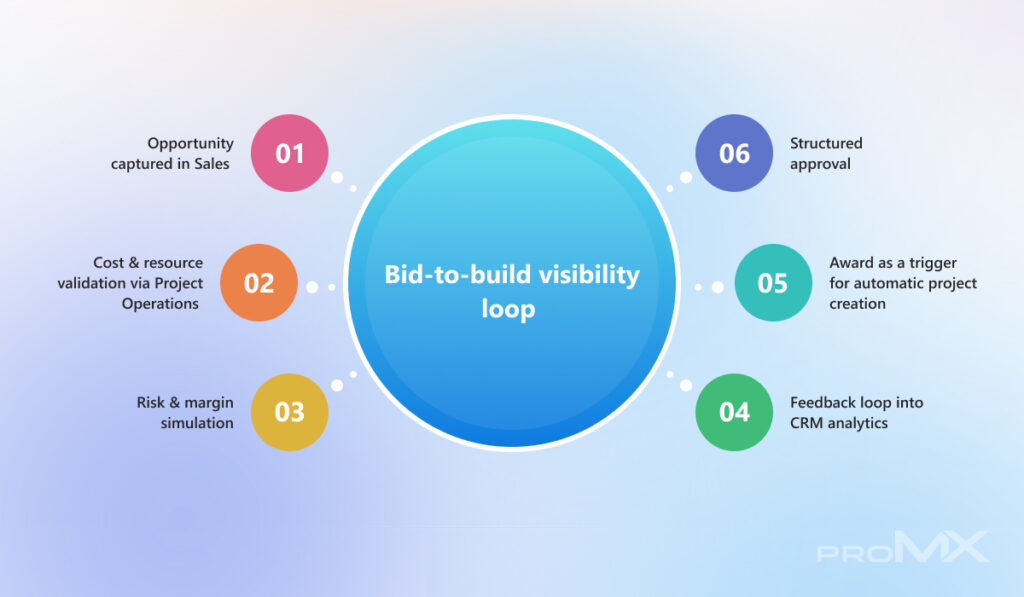
5. Turning data into competitive intelligence
Construction firms increasingly compete not only on price, but on predictability and reliability. Dynamics 365 Sales provides a set of instruments to mitigate the risks for your budget and image:
- Win/loss analysis
- Margin trend monitoring
- Tender performance tracking
- Customer relationship insights
- Forecast accuracy measurement
Over time, this builds strategic insight into which types of tenders are most profitable, the causes for margin erosion, or which clients are most likely to generate repeat value.
Conclusion
Most construction organizations struggle because the system landscape makes it hard to work cleanly, not because people aren’t working hard. This is where proMX’s approach is a strong match, especially if you want more than generic CRM.
We position ourselves as a long-standing Microsoft Dynamics partner supporting organizations implementing Dynamics 365 and related technologies. If you are interested in getting to know more about the Sales app, the successor to Microsoft Dynamics CRM, sign up for our free 2-hour briefing!
In a focused session, we will guide you through the solution based on the sales process and cover the following points:
- Lead generation based on a business card or Outlook mail
- Lead qualification according to selected criteria
- Handling of sales opportunities based on the opportunity sales process
- Follow-up of customer communication (by phone and email)
- Quotation generation based on existing information
- Sending offers by email and storing them on SharePoint
FAQ
How can we keep track of all client interactions during long sales cycles?
With Microsoft Dynamics 365 Sales, all client communication can be stored in one centralized system. This way, everyone involved in the deal has a complete view of the relationship and the current status of the opportunity, even when sales cycles span many months.
How can we improve forecasting for upcoming construction projects?
Dynamics 365 Sales provides pipeline visibility and forecasting tools that help organizations analyze opportunities, deal stages, and probabilities. This allows teams to build more accurate revenue forecasts based on real-time sales data and the progress of ongoing bids and negotiations.
How can sales and project teams collaborate better once a deal is won?
When a project moves from bidding to execution, important details can easily get lost. By implementing solutions based on Microsoft Dynamics 365, companies can make sure project teams have access to the original opportunity data, client information, and scope details. Partners like proMX help design processes that support a smoother transition from sales to delivery.



RECENT POST
OUR EVENTS